


_Summary
The decision regulatory and compliance leaders actually face
If you’re responsible for ESG reporting, regulatory compliance, sustainability, or supply chain due diligence, the question isn’t whether AI can generate an answer. The real question is whether you can stand behind that answer during an audit, customer assessment, regulatory inspection, or internal review.
That distinction matters because many AI tools look remarkably similar. Most can summarize documents, answer questions, and generate convincing text. Yet beneath the surface, there is a significant difference between a general-purpose chatbot with document upload capabilities and an AI platform designed specifically for regulatory work.
Understanding that difference helps explain why some systems become trusted parts of compliance workflows while others remain useful only for drafting or brainstorming.
Why uploading documents isn’t enough to train AI
One of the most common misconceptions about AI is that uploading documents somehow teaches the model your business.
It doesn’t.
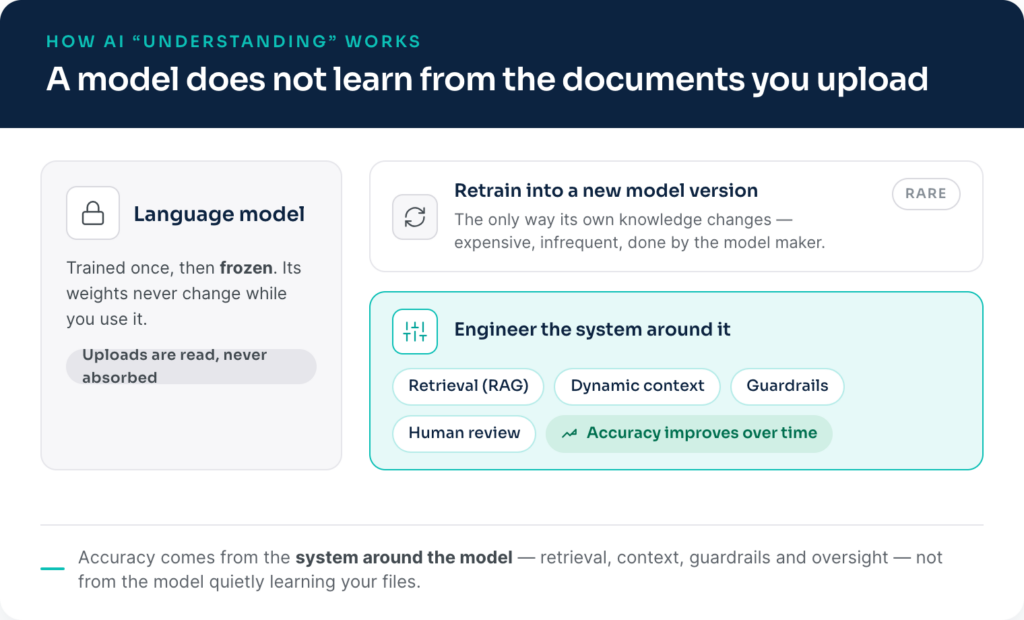
Once a language model has been trained, it does not continuously learn from the documents you upload. Your reports, policies and regulatory documents are not absorbed into the model’s knowledge. Instead, they are treated as external information that the system must locate whenever you ask a question.
Think of inviting someone into a vast regulatory library.
Every document they need is available, but unless they know exactly where to look and understand the language used in different regulatory frameworks, they may confidently return with the wrong document.
Large language models behave in a similar way. When they don’t have the right information, they often generate the most plausible-looking answer rather than admitting uncertainty. This phenomenon — known as hallucination — is one of the main reasons generic AI tools should not be relied upon for regulatory reporting without additional safeguards.
Improving accuracy therefore isn’t simply a matter of using a newer AI model. In practice, accuracy depends much more on how the surrounding system retrieves information, interprets regulatory context, and determines when human review is required.
Why retrieval helps, but isn’t enough
Most enterprise AI platforms today rely on Retrieval-Augmented Generation (RAG).
Rather than asking the language model to answer from memory alone, the system first searches your documents for relevant evidence. It then instructs the model to generate its answer using those specific sources, or to acknowledge when the necessary information cannot be found.
This approach significantly improves reliability compared with generic chatbots and has become the baseline architecture for enterprise AI.
However, retrieval alone does not guarantee trustworthy answers.
A 2025 study by Stanford researchers evaluated several leading commercial legal AI platforms. These systems were developed specifically for legal research, used Retrieval-Augmented Generation, and searched carefully curated legal databases. Despite these advantages, researchers still found incorrect or unsupported answers in 17% to 33% of tested queries.
The lesson is important for every compliance and sustainability team: having retrieval is not the same as having reliable retrieval. The quality of the search, and whether the system truly understands what it is looking for, determines the quality of the final answer.
Why regulatory context matters more than keywords
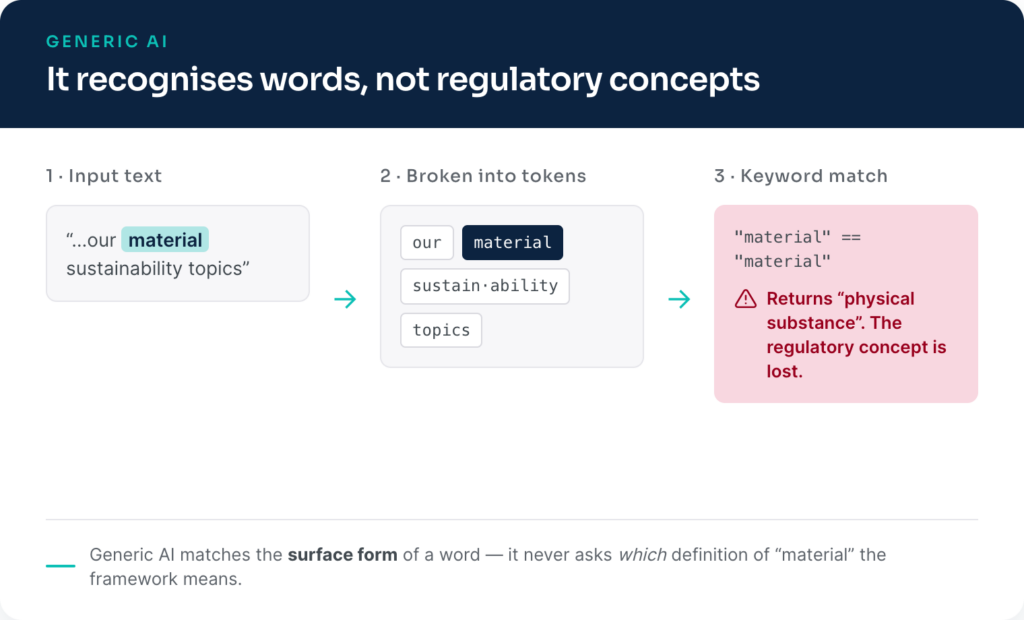
Regulatory documents often use familiar words in highly specialised ways.
Take the word “material.” In everyday language, it refers to a physical substance. In financial reporting, materiality describes whether information could influence an investor’s decisions.
Under the European Sustainability Reporting Standards (ESRS), the concept expands further through double materiality, where a topic may be material because of its impact on people or the environment, regardless of its financial effect on the company.
The same word therefore represents different concepts depending on the regulatory framework. The challenge extends well beyond materiality.
Similar differences appear across ESRS, EU Taxonomy, SFDR, DORA, CRR3, Pillar 3, and many sector-specific frameworks.
A generic search engine treats these as matching keywords. A specialised regulatory platform recognises them as different concepts before it begins searching. That distinction often determines whether the answer is useful, or confidently wrong.
What specialised AI should provide
When evaluating AI platforms for regulatory or ESG work, the underlying language model is only one part of the solution. More important are the capabilities built around it.
A specialised platform should provide:
- Retrieval that understands document structure, recognising that sections, clauses, tables and annexes carry meaning beyond individual words.
- Regulation-aware search, distinguishing regulatory concepts rather than relying on keyword matching alone.
- Answers that are fully traceable, allowing every statement to be linked directly back to supporting evidence.
- Outputs aligned with regulatory workflows, such as ESRS datapoints, CDP questionnaires or Pillar 3 reporting fields rather than generic narrative text.
- Built-in human oversight, ensuring uncertain responses are flagged for expert review instead of being presented with the same confidence as verified answers.
- Appropriate deployment options and data governance, supporting organisational requirements for security, confidentiality and data residency.
These capabilities, not simply the choice of language model, determine whether an AI platform can be trusted within a regulated environment.
How this looks in practice: AI specialized for ESG and regulatory compliance
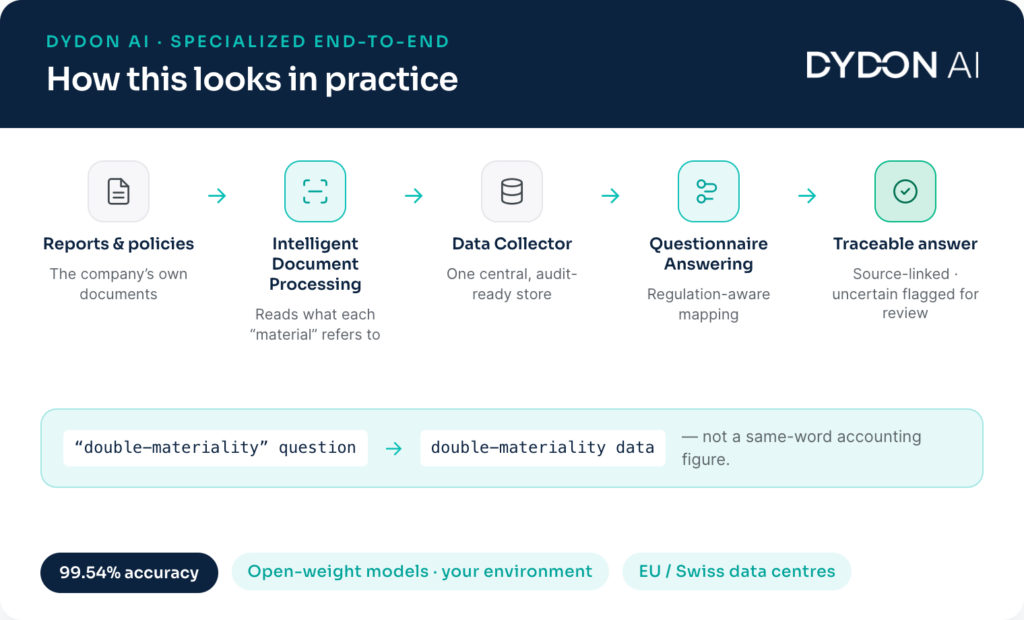
This is what DYDON AI’s Compliance platform is built to be, not a generic chatbot with your documents attached, but a system specialized end-to-end for ESG and regulatory work.
Take a corporate answering a customer’s ESG questionnaire about its “material sustainability topics”: the same word from before, now in a real workflow. Our Intelligent Document Processing reads the company’s own reports and policies, understanding what each mention of “material” actually refers to, and structures it into one central, audit-ready Data Collector.
Our Automatic Questionnaire Answering engine then maps each question to the right data using regulation-aware logic — so a double-materiality question pulls double-materiality data, not a same-word accounting figure — with every answer linked to its source and anything uncertain flagged for human review.
This reasoning is behind the 99.54% accuracy rate Dydon AI reached on a specialised regulatory reporting workflow for a financial institution, not from a more powerful model, but from domain-aware extraction, questionnaire logic, and full source traceability. The other half: Dydon AI runs on open-weight models deployed inside the client’s own environment or EU/Swiss data centres, so sensitive documents never leave a secure environment just to get an answer.
Five questions to ask any AI vendor
When evaluating AI for ESG or regulatory compliance, consider asking these questions:
- How does the system retrieve information from our documents? Is retrieval designed for regulatory content, or is it generic keyword search?
- Can every answer be traced back to its source? If evidence cannot be verified, neither can the answer.
- How does the platform distinguish regulatory concepts with multiple meanings? Understanding context is as important as finding keywords.
- What happens when the AI is uncertain? Reliable systems should identify uncertainty and involve human reviewers rather than guessing.
- Where is our data processed and stored? Technical capability should be matched by appropriate security, governance and data residency.
The model isn’t the product
Discussions about AI often focus on whether a platform uses GPT, Claude, Gemini or another language model. For regulatory teams, or any other specialised team, however, that is rarely the most important question.
The real question is whether the AI platform can consistently retrieve the right evidence, understand regulatory context, produce traceable answers and support human oversight. Those capabilities are what separate a generic AI chatbot from AI designed for ESG and regulatory compliance.
If you’re evaluating AI for regulatory work, don’t ask only Which model does it use? but instead ask whether the entire system has been engineered for the responsibilities your team carries.
Want to understand what AI genuinely specialized for your documents and regulatory context would look like? Our experts are available to make a free AI-potential analysis of your situation, get in touch to book your meeting.
Sources
- Lewis, P. et al. (2020). Retrieval-Augmented Generation for Knowledge-Intensive NLP Tasks. Meta AI Research / NeurIPS 2020.
- Magesh, V. et al. (2025). Hallucination-Free? Assessing the Reliability of Leading AI Legal Research Tools. Journal of Empirical Legal Studies, Stanford RegLab & Stanford HAI.
- Google Research (2026). Enterprise RAG hallucination-reduction benchmark findings, cited in 2026 enterprise AI reliability literature.
- EFRAG. European Sustainability Reporting Standards (ESRS) — double materiality guidance.
- IFRS Foundation / IASB. Definition of materiality in financial reporting (IAS 1 / Conceptual Framework).